
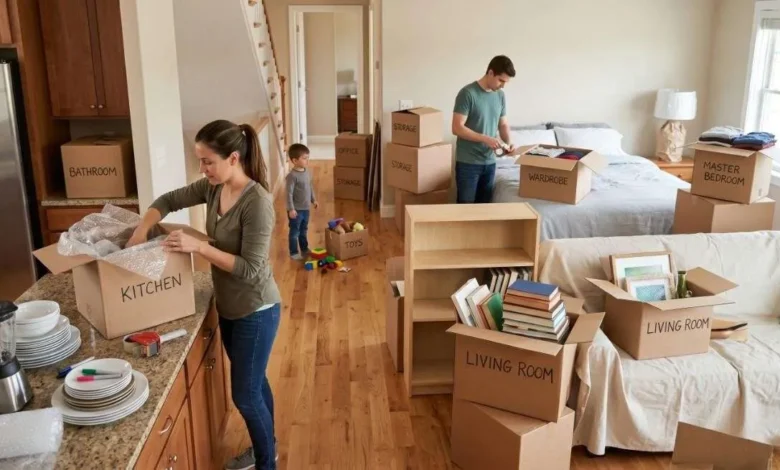
Many individuals start planning a move by considering the final location, the size of the truck, the moving date, the new address. Packing is generally perceived as a single task. This is the reason why you don’t label your boxes, your plates end up breaking, and your kitchen isn’t functional for a couple of weeks. A strategy that involves packing room by room will give you a different perspective: each room will be considered a separate project, with its own packing order, supply checklist, and reasoning.
Before You Pack a Single Box, Cut What You’re Moving
The most efficient way to pack is to make some decisions well before you start boxing things up. This month before you really start preparing to move, set aside five minutes every day to visit a room in your home and declutter in a very focused way. Pick a small area, a drawer, a shelf, a corner, and pull out three containers: one for things to keep, one for things to donate, and one for things to trash. Then just sort that one spot. Do it every day and by moving day you will have separated out a lot of things you wouldn’t otherwise need to pay to pack, carry, and unpack.
Estimate Costs Before You’re Committed to a Number
Knowing the volume of what you’re moving room by room gives you something genuinely useful: an accurate basis for estimating your total relocation cost before you’ve signed anything or hired anyone. The number of boxes per room, the presence of specialty items like a piano or large appliances, the distance to the new home, these variables determine what the job actually costs.
The AllMovers moving cost calculator lets you input your specific situation and get a realistic projection, which is far more useful than a ballpark figure that doesn’t account for the full picture. Run the estimate before you finalize your moving budget, not after.
Packing supplies are part of that budget too. Dishpacks cost more than standard boxes. Wardrobe boxes are a separate line item. Anti-static wrap, stretch wrap, and packing paper add up quickly if you’re outfitting a full 3-bedroom house. Anything you can do to reduce the quantity or expense of the packing supplies helps, and the cost of all these items can normally be included in any moving quotes you seek.
The Kitchen: The Most Labor-Intensive Room in the House
The kitchen typically takes more time to pack than any other room in the house. Heavy and fragile items paired with the most difficult-to-stack shapes makes packing the kitchen a monstrous part of the moving process. To keep your wits and all your wine glasses about you, we recommend breaking the process down into three easy-to-tackle categories: cookware, pantry, and glassware.
Cookware
- Nest pots and place packing paper inside each one to prevent rattling.
2. Lids are best packed upright and not flat with paper surrounding them as well.
3. Cast-iron and other painfully heavy ceramic pans should be packed alone in small boxes. Never pack these heavy hitters at the bottom of a large box with a cluster of other kitchen items on top.
Plates and China are best packed in a “dishpack box”. These double-walled boxes are designed specifically for your kitchen’s fragile items. Pack plates vertically in dishpacks by placing them on edge like vinyl records in a crate. Plates stacked flat will crack under the extreme pressure caused by the massive box of books that you placed on top of them. Standing plates on edge evenly distributes the pressure along their strongest axis ultimately saving you from cracking under the pressure and protecting your plates from breaking.
Rule one of pantry packing is anything liquid gets a little bit of plastic wrap under the cap before the lid goes back on. If you skip this step, you will have a disaster in transit and find olive oils, soy sauce, and vinegar all over everything when you open your moving boxes. Cans or sealed bags can be simply boxed up like anything else. Anything that you’ve opened and is no longer sealed goes in the trash.
Living Room Electronics: Documentation Before Disconnection
It is a good idea to take a picture of the back of every device that has multiple cable connections before you unplug anything. This makes it easier for you to know where each cable goes when you are setting everything up in your new location. To keep your electronics from being among the 900 million things that are jostled around and damaged during a typical moving season, namely, electronics and their peripherals, they also need to be packed with care.
Whenever possible, use the original boxes. The molded-foam inserts that electronics manufacturers use are the most perfect, snug fit your device had since it was created, and there’s no way that generic bubble wrap you’ve repurposed from moves past is going to give it that level of protection. If you haven’t hoarded the original packaging like a crazy person, then anti-static bubble wrap is your friend. Don’t use regular bubble wrap, it can lead to a static charge building up over the surface of a piece of electronic equipment, crippling it over time.
Cables get coiled loosely (not tightly wound, which stresses the connectors), secured with Velcro ties, and labeled with a piece of masking tape noting which device they belong to. Batteries come out of remotes and small devices before packing, they can corrode or leak during a long move.
Bedrooms: Work Smarter on Soft Goods
Packing up your bedrooms for a move is easy. Clothing and soft items are significantly less prone to damage than most of your other items and don’t require any special containers. The only danger is wasting space and ending up with unnecessary boxes, so follow these packing tips to cut down on box count and give yourself extra room in the moving truck.
Hanging clothes are the first step counterpart to mirrors and pictures: a wardrobe box. This gigantic, incredibly sturdy, easily movable box comes with a metal bar that spans the inside top to become the “closet rod” for your garments. Simply transfer your shirts, pants, and jackets from your closet bar to the wardrobe box closet bar, and bing bang boom: done. You can fit most of a standard closet in 2 wardrobe boxes. It’s faster to pack and unpack than folding and putting clothes in a box, and your clothes will be wrinkle-free enough that you won’t notice the difference.
On to dressers. Leave the clothes in the drawers they’re in. Wrap the whole thing in stretch wrap, which serves the dual purpose of holding the drawers shut and keeping their contents contained while also not sticking to the finish like tape would. This gets you a good half-dozen fewer boxes per bedroom and makes the dresser much easier to carry since the heavy items are distributed inside the frame rather than consolidated into densely-packaging boxes.
Mattresses flat-out need a mattress bag. It’s just so important to keeping them safe and dry in the move. They’re big and heavy but also designed to easily slide the mattress in. Make sure you have one before moving day.
Bathrooms: Small Rooms With Specific Risks
Bathrooms may not take long to pack, but they are one of the easiest rooms to get wrong. Liquid leaks and unnecessary items are the usual suspects.
Use the pantry bottle rules for every liquid toiletry: plastic wrap under the cap and screw the lid back on. Pack into a sealed bin rather than a box. Meds need to be assessed pre-packing. Dispose of expired items responsibly. No point packing and moving them to sit in your new cabinet all year.
Pack a separate first-week toiletry bin that rides in your vehicle or is the very first bin unloaded at the new place. Toothbrushes, soap, shampoo, toilet paper, towels, all of it goes in there. No one wants their toothbrush and toilet paper held hostage in a taped-up box for a week.
Garage and Storage: The Most Hazardous Room to Pack
There are certain items that are commonly found in garages and that just aren’t suitable for loading onto a moving truck with everything else: non-allowables. These include a range of things that almost every household garage likely contains, that are hazardous or dangerous to transport, and that professional moving companies are legally barred from transporting. Common non-allowables for most major carriers can include aerosol cans, paint, household cleaners, fuel, pesticides, propane tanks, and more.
Anything with a gas tank obviously can’t be loaded on a truck full of furniture, so run the lawnmower (or use a hand pump if you have to) until the tank is dry before your moving day. The same goes for gas-using power tools. Insist on taking the time to drain these items if you’re using professional movers, but also consider that driving a moving truck down the highway with a flammable gas tank in the back is a risky idea even if you’re behind the wheel.
For safety, wrap the blades of sharp tools like rakes, shovels, or pruning shears in old blankets, or shove them into cardboard sleeves from an old box, and tape the container shut. Clearly label the box as containing sharp garden tools and be sure that no edge is exposed when the box is opened. Flammable, reactive, or pressure-filled items will need to be used, given away, or properly disposed of in the weeks before your move.
Labeling: The System That Determines How Fast You Unpack
A color-coding method is used to assign a specific color for each room, blue tape for the kitchen, red for the master bedroom, green for the home office. Then, put a strip of that color tape on two sides of every box that goes to that room so that it doesn’t matter how the boxes are placed, it’s still visible. In the new home, if there is a matching colored sign or piece of tape in the door frame, the movers know where to put the boxes, they don’t even have to ask.
Color coding alone isn’t enough though. Pair it with a numbered box system tied to a digital inventory spreadsheet. Box 14 (Blue – Kitchen) Equals: dishpacks, wine glasses, mixing bowls. Now when you really need a glass of wine before everything’s unpacked, you’re just looking for one number, not all the blue kitchen boxes.
This dual system also protects you if anything goes missing or arrives damaged. An inventory that documents what was in each box, and the condition it was in when packed, gives you a clear record for any insurance or claims process.
The Day One Box: The Last Thing Loaded, the First Thing Opened
The gap between when the last box gets loaded and when you can reasonably start unpacking it is torturous for every member of the household. It’s a long day and it’s even longer if, on top of exhaustion, you’re coping with late afternoon-into-evening hunger, dehydration, or desperate lack of a favorite catnip mouse.
You can’t do anything to get your stuff on the truck faster, but you can make sure you’ve got some essentials for the first 24 hours at the new place and that they’re easy to grab the second you arrive. Select and designate a plastic lidded bin’s worth of items you absolutely, positively want last on the truck and first off the truck. Phone chargers, a basic set of hand tools, toilet paper, trash bags, paper towels, a change of clothes per person, and enough basic cookware to make one simple meal. If you have young children or pets, their first-night essentials go in this same bin.
This box loads last and unloads first. Label it clearly enough that anyone on the crew knows not to stack it at the back of the truck.
The Move is Just Logistics
A household move isn’t inherently overwhelming, it’s a large logistics problem that gets manageable when it’s broken into pieces. Each room has a distinct set of challenges, and addressing them separately means you’re solving specific, bounded problems rather than one enormous vague one. Get the decluttering done early, pack room by room in a logical sequence, label everything with a system you’ll actually use, and know your cost picture before moving day arrives.
